
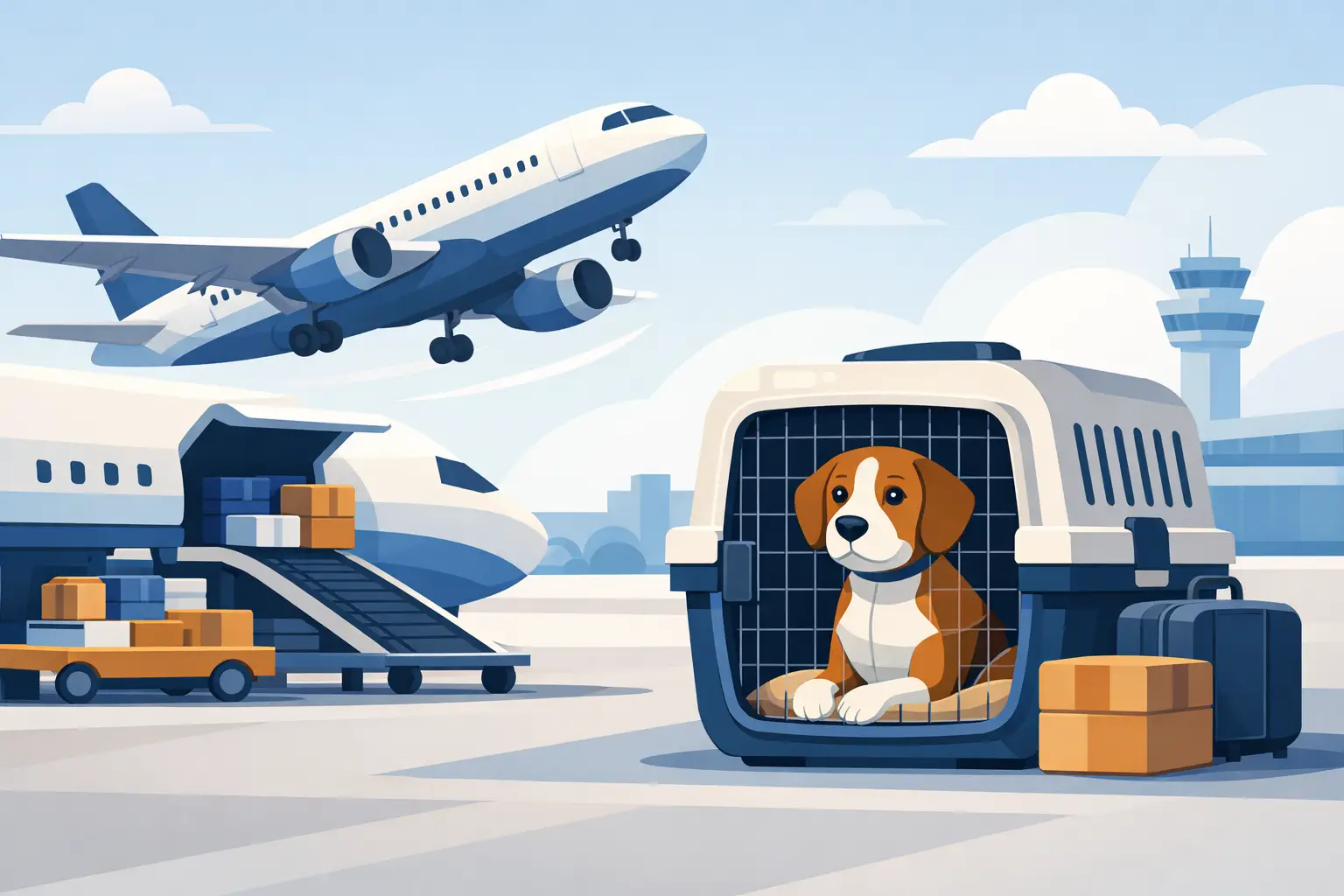
Can Dogs Fly in Cargo Safely?
A dog booked into cargo is not being treated like a suitcase. That distinction matters, because the answer to can dogs fly in cargo safely depends less on the word cargo and more on the airline, the aircraft, the route, the season, and the planning behind the trip.
For many families, breeders, and organizations, cargo transport is the only practical option. Large dogs often cannot travel in the cabin. International moves may require specific airline procedures, approved kennels, health documentation, and transit coordination that only exist through manifest cargo programs. When the process is handled properly, dogs can and do fly safely in cargo every day. But safe transport is never something to leave to chance.
Can dogs fly in cargo safely under the right conditions?
Yes, in many cases they can. Modern live-animal cargo programs are designed for transport, not freight storage. On appropriate aircraft, dogs travel in a pressurized, temperature-managed compartment separate from general baggage handling concerns. Airlines that accept live animals under established protocols typically have procedures for check-in timing, kennel standards, loading priority, and animal welfare restrictions.
That said, safe is not the same as risk-free. Air travel introduces stress, noise, environmental change, and handling transitions. A healthy adult dog on a direct flight in mild weather is very different from a brachycephalic breed moving through a hot connecting airport in summer. The first scenario may be quite manageable. The second may be unsuitable or require an entirely different routing strategy.
The real question is not whether cargo is inherently unsafe. It is whether the specific trip has been designed around the dog.
What actually makes cargo travel safe or unsafe
The biggest safety factors are usually route selection, temperature exposure, kennel setup, and fitness to fly. Owners often focus on the aircraft itself, but problems are just as likely to arise during ground time. A dog can be comfortable in flight and still face avoidable risk on a long tarmac delay, a poorly timed layover, or a rushed handoff between facilities.
Direct flights are usually preferable because they reduce transfers, waiting periods, and opportunities for disruption. If a connection is necessary, the quality of the transit station matters. Some airports are far better equipped for live-animal handling than others, with trained staff, designated animal areas, and more dependable transfer procedures.
Weather is another major variable. Airlines may restrict pet travel during periods of high heat or extreme cold, and those limits exist for good reason. Even when aircraft holds are climate controlled, parts of the journey involve movement across ramps and between secure handling areas. A route that is safe in March may not be appropriate in July.
Kennel preparation also has a direct effect on welfare. A crate that is too small, poorly ventilated, or incorrectly assembled creates unnecessary stress and can become a handling problem. The dog must be able to stand naturally, turn around, and lie down comfortably. Absorbent bedding, secure water provisions, and proper labeling are not small details. They are part of the safety system.
Which dogs may not be good candidates for cargo
Not every dog should fly in cargo, and responsible transport planning starts with that reality. Senior dogs with fragile health, very young puppies, dogs with respiratory compromise, and pets recovering from illness or surgery may face elevated risk. Snub-nosed breeds deserve particular caution because airway issues can become more serious under travel stress.
Temperament matters too. A dog that panics in confinement or becomes highly reactive around unfamiliar sounds and motion may need a different travel plan or a longer conditioning period before flying. Cargo safety is not only about physical condition. Emotional stability during transport plays a role in how well a dog handles the journey.
This is one reason one-size-fits-all advice can be misleading. Some dogs travel calmly and recover quickly. Others need route changes, travel postponement, veterinary review, or an alternate mode of transport.
How professional planning lowers risk
Experienced animal transport coordination changes the equation. Instead of booking whatever flight appears available, a specialist evaluates airline acceptance rules, aircraft type, airport capabilities, climate conditions, breed considerations, import requirements, and the timing of each handoff.
That level of planning reduces preventable problems. It can mean choosing an early morning departure to avoid heat exposure, avoiding airports with weak transfer infrastructure, building in the correct document checks before departure, or selecting a manifest cargo process rather than a less controlled booking path. It can also mean advising a client not to move forward on a proposed route because the conditions are not right.
For international moves, the margin for error gets smaller. Health certificates, vaccination timelines, import permits, customs handling, and country-specific kennel rules can all affect whether a dog travels smoothly or faces delay. Delays are more than inconvenient when a live animal is involved. Good planning is a welfare issue.
Preparing a dog for safe cargo transport
A dog should never meet its travel kennel for the first time on departure day. Crate acclimation is one of the most useful steps an owner can take. When a dog already sees the kennel as a familiar resting space, the trip begins from a calmer baseline.
Feeding schedules should follow veterinary and airline guidance, with enough time before departure to reduce discomfort while still keeping the dog appropriately cared for. Hydration matters, but so does setting up spill-resistant water access for the trip. Exercise before airport check-in is usually helpful because it allows the dog to relieve itself and settle more easily.
Documentation should be reviewed early, not at the last minute. That includes vaccination records, health certificates, import paperwork if applicable, and any airline-specific forms. Small mistakes create large complications in live-animal shipping.
Sedation deserves special mention. In most cases, routine sedation for air travel is not recommended unless specifically directed by a veterinarian who understands the flight conditions and the individual dog. Sedatives can interfere with breathing, balance, and temperature regulation. A calmer dog is not automatically a safer dog if that calm comes from medication that reduces physiological stability.
What owners should ask before booking
If you are trying to decide whether cargo is appropriate, the most useful questions are practical ones. Is the dog medically fit to fly? Is there a direct route? What aircraft and airline procedures are being used for live animals? What are the temperature limits on every segment of the trip? Who is responsible for the dog at each stage, including transit and arrival?
You should also ask what happens if a delay occurs. Contingency planning is part of safe transport. A credible provider should be able to explain how disruptions are managed, where the dog would be held if necessary, and how communication will be handled throughout the process.
Reassurance is important, but specifics matter more. General promises do not protect animals. Clear operational answers do.
Can dogs fly in cargo safely for international relocation?
International relocation often makes cargo travel the correct option because many countries and airlines require structured animal handling channels. In these cases, cargo is not the rougher alternative. It is often the more controlled and compliant method.
With international transport, the challenge is not just getting the dog on a plane. It is maintaining welfare while meeting legal entry requirements, coordinating ground handling, and avoiding documentation errors that could lead to refusal or quarantine complications. This is where specialized providers such as Global Animal Transport bring real value – not by treating cargo as a simple booking, but by managing it as a live-animal operation.
A well-managed international move considers the dog’s breed, age, medical profile, origin and destination climate, local import laws, and the practicality of each route. Sometimes the safest plan is a straightforward cargo itinerary. Sometimes the safest plan is delaying the move until weather conditions improve.
For most owners, the question carries understandable emotion. Sending a dog in cargo feels unfamiliar, and unfamiliar can feel unsafe. But the better standard is not emotion alone. It is whether the journey has been built around humane handling, appropriate equipment, qualified oversight, and realistic risk assessment.
When those pieces are in place, cargo can be a safe and responsible way for dogs to travel. The right next step is not guessing. It is getting the trip evaluated by professionals who understand that every animal movement is both a logistics job and a duty of care.
If your dog needs to travel, the safest plan is the one designed for your dog’s actual needs, not the fastest booking on the screen.
