
Primate Transport Protocols That Put Welfare First
A primate shipment can be compromised long before an aircraft departs. An incomplete import permit, a crate that does not suit the animal’s movement needs, or an unfamiliar handoff team can create unnecessary risk. Effective primate transport protocols address those details early, treating every move as a coordinated animal welfare operation rather than a standard cargo booking.
For zoos, sanctuaries, conservation programs, breeders, research organizations, and licensed animal facilities, the goal is not simply to reach the destination. It is to protect the animal’s health, safety, social needs, and regulatory status at every stage of a domestic or international journey.
Why Primate Transport Requires Specialized Planning
Primates are intelligent, highly observant animals that may be sensitive to changes in routine, unfamiliar sounds, confinement, and separation from familiar caregivers or group members. Their transport plans must account for behavior as carefully as they account for flight schedules and border requirements.
The appropriate plan depends on the species, age, medical history, temperament, social structure, origin, destination, and length of transit. A short domestic transfer and an intercontinental relocation do not carry the same operational demands. Some animals may travel with a compatible companion when appropriate and approved, while others require individual accommodation to prevent injury or distress. These decisions should be made by qualified animal care and veterinary professionals, not by convenience alone.
Transport also takes place within a strict regulatory environment. Requirements may involve wildlife permits, import and export approvals, veterinary health certificates, airline acceptance standards, quarantine arrangements, customs clearance, and destination-specific rules. For protected species, international trade controls may apply. Documentation must match the animal, the itinerary, and the receiving facility exactly.
Primate Transport Protocols Begin Before the Booking
A safe move starts with a complete pre-transport assessment. The transport coordinator should gather accurate species identification, individual records, ownership or institutional authorization, microchip or other identification details where applicable, and current veterinary information. This establishes the foundation for permits, airline planning, and arrival procedures.
Veterinary Fitness and Health Preparation
A veterinarian familiar with the species should determine whether an animal is fit to travel. The assessment may include a physical examination, required diagnostic testing, vaccination review where applicable, parasite control, and preparation of official health documentation. Timing matters because certificates and laboratory results often have limited validity periods.
Veterinary planning should also address medication needs and contingency instructions. Sedation is not a routine substitute for proper handling and crate conditioning. It can affect an animal’s ability to regulate body temperature, balance, and respond normally during transit. If medication is necessary, it should be directed by the attending veterinarian and communicated clearly to the trained personnel responsible for the shipment.
Documentation and Regulatory Coordination
International primate movements frequently require coordination among government agencies, veterinary authorities, carriers, customs officials, and receiving institutions. A single document error can result in a delay, refusal of entry, or extended holding period that places avoidable stress on the animal.
A professional transport plan verifies the required permits before routing is finalized. It also considers whether the transit country has requirements, not only the origin and destination. Flight connections, airport operating hours, inspection procedures, and quarantine arrangements should be confirmed well in advance. Last-minute changes are sometimes unavoidable, but they should never be the operating model for a complex live-animal move.
Crate Design Is a Welfare Decision
The transport container is the animal’s immediate environment for the duration of the journey. It must be secure enough to prevent escape or injury while providing appropriate space, ventilation, visibility control, and protection from weather and handling activity. Container requirements must meet airline and applicable live-animal transport standards, but compliance is the minimum threshold. Species-specific suitability is the objective.
A properly designed primate crate allows the animal to stand and reposition naturally while limiting opportunities for harmful contact with external surfaces. It should have secure doors and fastenings, absorbent flooring where appropriate, spill-resistant water provisions, and feeding access that can be managed without unnecessary exposure. Materials, mesh spacing, and internal features should reflect the animal’s size, strength, dexterity, and behavior.
Whenever possible, crate familiarization should happen before travel day. Introducing the container gradually in the animal’s normal environment can reduce fear and make loading less disruptive. Familiar bedding or approved enrichment may be helpful in some cases, but every item must be evaluated for safety, sanitation, airline requirements, and the risk of ingestion or entanglement.
Managing Welfare Through Each Handoff
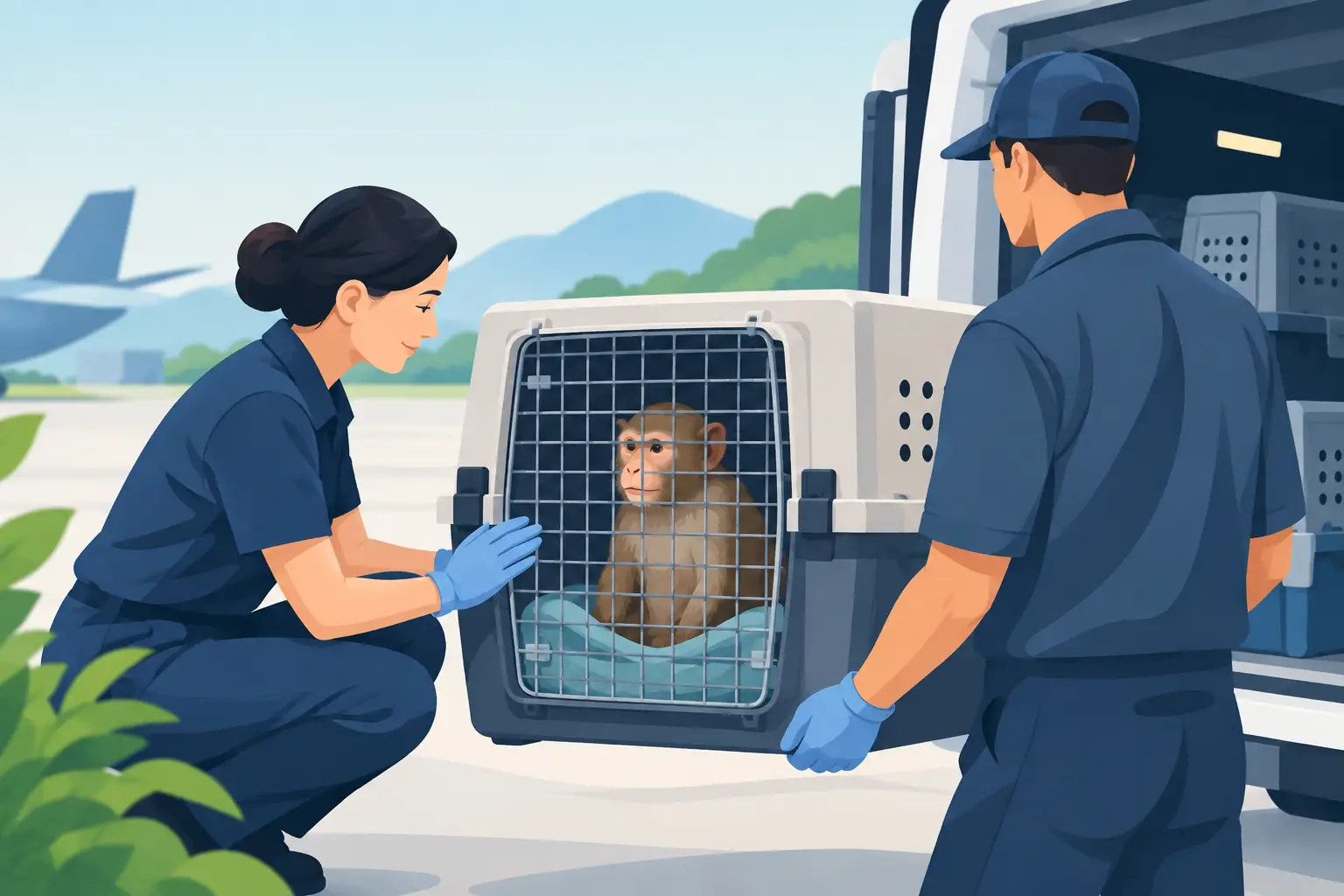
The highest-risk moments in animal transport are often the transitions: departure from the home facility, loading, aircraft transfer, customs inspection, arrival, and final delivery. Primate transport protocols should identify who is responsible at each point and how information will move between teams.
Ground transport should use a climate-controlled vehicle when conditions require it, with secure crate placement and a direct route to the airport or destination facility. Excessive waiting, unnecessary transfers, and exposure to crowds or loud environments should be minimized. Departure timing should account for traffic, airport acceptance windows, and seasonal weather, rather than relying on the latest possible arrival.
At the airport, experienced live-animal handlers should understand the shipment’s care instructions, crate orientation, and loading requirements. The animal should not be left on a hot ramp, in freezing conditions, or in an uncontrolled holding area. For long or complex itineraries, the plan should confirm where the animal will be held, who can access it, and what will happen if a flight is delayed or canceled.
Communication is equally important. The sending facility, transport coordinator, veterinarian when needed, carrier, and receiving team should have clear contact information and escalation procedures. A 24-hour point of contact provides essential reassurance when a schedule changes outside standard business hours.
Feeding, Hydration, and Environmental Control
Feeding schedules should be tailored to the individual animal and journey length. Overfeeding immediately before departure may not be appropriate, yet the animal must have safe access to water and, when required, suitable food during transit. Instructions should be specific about diet, quantities, timing, and any prohibited foods.
Temperature control deserves close attention. Primates can be vulnerable to heat and cold stress, especially during ground transfers or unexpected delays. Seasonal routing, vehicle climate control, aircraft conditions, and destination weather must all be considered. The right route is not always the shortest route if another itinerary offers more reliable live-animal handling or fewer high-risk connections.
Noise, light, and visual stimulation can also affect welfare. Some animals benefit from reduced external visual activity, while others require careful monitoring. There is no universal setup. The transport team should follow the species guidance and welfare plan established for that individual shipment.
Arrival Is Part of the Transport Plan
A shipment is not complete when the aircraft lands. Customs clearance, veterinary inspection, quarantine release, and transfer to the receiving facility must be organized before departure. Delays at arrival can undermine the careful planning that occurred earlier in the journey.
The receiving team should be prepared with a secure vehicle, appropriate holding space, water, food, and a quiet acclimation area. They should know the expected arrival time, identification details, handling instructions, and any veterinary observations made during transit. After arrival, the animal may need time to rest and reestablish a familiar feeding and care routine before being introduced to a new enclosure or social group.
Global Animal Transport coordinates specialized animal logistics with attention to permits, routing, species-specific handling, and welfare at every handoff. For primate relocation, that level of coordination is not an added convenience. It is the standard of care the animals deserve.
When a primate move is being considered, begin planning before dates are fixed or flights are requested. Early consultation gives the care team time to evaluate the animal’s needs, confirm regulatory pathways, and build a route that protects welfare from the first crate introduction to a calm, prepared arrival.
