
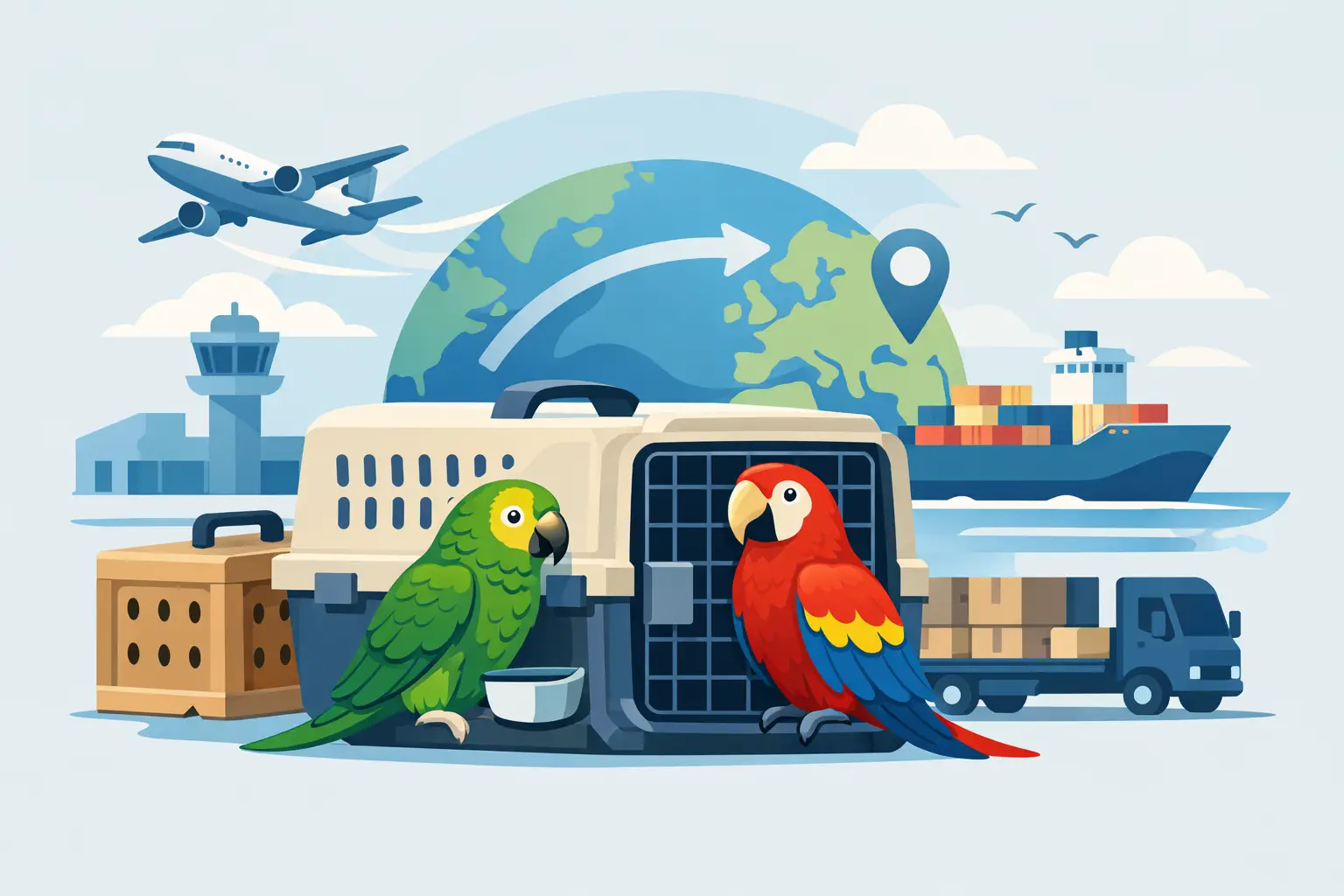
How to Ship Parrots Internationally Safely
A parrot can cross a border legally on paper and still be unfit to travel in practice. That is the hard part many owners, breeders, and institutions discover too late. If you are researching how to ship parrots internationally, the real job is not booking space on an aircraft. It is building a transport plan that protects the bird’s health, meets import and export rules, and avoids preventable delays that can put a sensitive species under unnecessary stress.
International parrot transport sits at the intersection of animal welfare, aviation logistics, and wildlife regulation. Even relatively common companion parrots can trigger documentation requirements that do not apply to dogs or cats. For protected species, the process becomes more controlled, with strict permit review, identity verification, and country-specific entry conditions. A successful shipment depends on getting every moving part right before travel day.
How to ship parrots internationally without costly mistakes
The first question is whether the shipment is legally allowed at all. Many parrots fall under CITES, the Convention on International Trade in Endangered Species of Wild Fauna and Flora. That does not always mean transport is prohibited, but it often means permits are required and timelines are longer. The species, the bird’s origin, the purpose of transport, and the destination country all matter.
A companion bird moving with a family may face one set of requirements. A breeder transfer, zoological move, or conservation shipment may face another. Some countries also impose quarantine, disease testing, microchip or band identification, and veterinary certification with very specific language. If even one line on a health certificate is incomplete, the bird may be held, refused entry, or rerouted.
This is why the planning phase carries so much weight. The most common failures are not dramatic in-flight events. They are paperwork gaps, incorrect crate sizing, poor routing choices, weather restrictions, and connections that were technically possible but never appropriate for a live bird.
Start with species, country, and airline rules
There is no universal checklist for every parrot shipment. An African grey, macaw, cockatoo, Amazon, or conure may each require different handling considerations, and the same species can face different entry rules depending on destination. Before any booking is considered, the shipment should be evaluated against three layers of requirements: export rules from the origin country, import rules at destination, and live animal acceptance standards from the airline or cargo operator.
Those layers do not always align neatly. A country may approve entry, while an airline refuses the routing because of temperature exposure or connection length. An airline may accept the species, while the destination requires permits that are still pending. That is why transport planning for parrots should be coordinated as one managed process rather than a collection of separate tasks.
For owners, this usually means gathering the bird’s species information, age, identifying band or microchip details if applicable, ownership history, veterinary records, and the exact destination address. For institutions and breeders, it also means confirming the shipment purpose and legal transfer documentation. The more precise the file is at the start, the fewer surprises appear later.
The crate is not just packaging
Parrots do not travel like standard cargo, and the crate is not simply a container. It is the bird’s temporary environment during one of the most stressful parts of relocation. Size, ventilation, perch placement, feeder access, structural strength, and species behavior all matter.
A crate that is too small can restrict posture and create distress. A crate that is too large can be just as problematic if the bird is thrown off balance during handling or turbulence. Strong beaks also change the risk profile. Materials, fasteners, and door security must be selected with the bird’s species and strength in mind.
Crate conditioning before transport is equally important. A parrot should not meet its travel crate for the first time at airport acceptance. When possible, gradual familiarity reduces panic behavior and can improve feeding and hydration during transit. Some birds adapt quickly. Others need more time and a quieter approach. That is one reason experienced animal shippers avoid one-size-fits-all preparation.
Food and water planning also deserves careful attention. Parrots have species-specific diets and can be sensitive to sudden changes. Travel feeding must balance nutrition with practicality. Overfilling dishes can create mess and contamination, while underplanning can leave the bird without adequate intake during delays. Humane transport is detailed transport.
Veterinary clearance matters, but timing matters just as much
A healthy-looking parrot is not automatically travel-ready. Many countries require an accredited veterinary exam and official health certificate issued within a narrow window before departure. Some also require diagnostic testing, treatment records, or statements related to infectious disease exposure.
Timing is critical because documents can expire quickly. If a permit is approved but the health certificate is issued too early, the shipment may miss compliance. If the airline booking shifts and the exam is issued too late for endorsement processing, the shipment may fail for a different reason. This is where coordination becomes more valuable than speed.
A veterinarian should also assess whether the bird is physically fit for the route itself. Long transfers, temperature extremes, prior illness, feather damage, and stress-related behaviors may all affect whether travel should proceed on the planned date. Sedation is generally not a simple answer for bird transport and may create additional risk. Decisions around medical preparation need species-aware veterinary judgment, not assumptions.
Routing can protect or undermine welfare
The shortest route on a screen is not always the safest route for a live parrot. Direct flights are often preferable when available, but not every direct option is practical for crate dimensions, live animal acceptance, or destination clearance. Sometimes a carefully managed connection is safer than a rushed direct booking with poor handling windows or temperature exposure.
Transit airports matter. So do the season, the time of day, and the amount of ground time required between flights. A route that places a tropical species on a hot tarmac or in winter transfer conditions may be a poor welfare choice even if it looks efficient from a logistics standpoint.
Professional planning focuses on controlled handoffs, realistic connection times, airport animal handling capabilities, and contingency options if flights change. The goal is not just movement. The goal is stable, compliant, humane movement.
How to ship parrots internationally with less stress for the bird
Reducing stress starts well before departure. A stable routine, familiar food, crate acclimation, and minimal last-minute changes help create a calmer baseline. On travel day, handling should be quiet, deliberate, and limited to what is necessary. Parrots are highly perceptive animals, and they often react quickly to noise, disruption, and unfamiliar restraint.
It also helps to avoid treating all parrots as interchangeable. Some species are more noise-sensitive. Some are more prone to defensive behavior. Some companion parrots are deeply bonded to one person and may become distressed when separated. For valuable breeding stock, rare species, or institutional birds, these behavioral patterns should shape the handling plan just as much as the paperwork does.
Communication with the receiving party is another part of stress reduction. Arrival procedures should be ready before the bird lands. That means prompt pickup, a quiet recovery environment, proper temperature, fresh water, and species-appropriate food. A well-managed arrival can make a major difference after a long transport cycle.
Why many international parrot shipments need specialist oversight
Parrot transport is one of those services where experience changes outcomes. The stakes are too high for guesswork, especially when CITES documentation, customs clearance, airline coordination, and species-specific welfare all have to line up at once. A transporter handling these moves should understand not only cargo operations, but live bird behavior, crate standards, veterinary timing, permit sequencing, and what to do if the route changes unexpectedly.
That level of oversight is especially important for zoos, aviaries, breeders, and conservation programs moving regulated or high-value birds. It is just as important for families relocating with a beloved companion parrot. In both cases, the bird is not freight in the ordinary sense. It is a living animal with legal protections and very real welfare needs.
At Global Animal Transport, that is the standard the work should meet: compliance without shortcuts, planning without guesswork, and handling that treats the bird’s safety as the center of the shipment rather than an afterthought.
If you are preparing for an international parrot move, the best next step is not rushing to book space. It is building a transport plan early enough to give the bird every advantage before wheels ever leave the ground.
